
 BizSpace Portal
 Payroll Portal
 Supply Chain Financing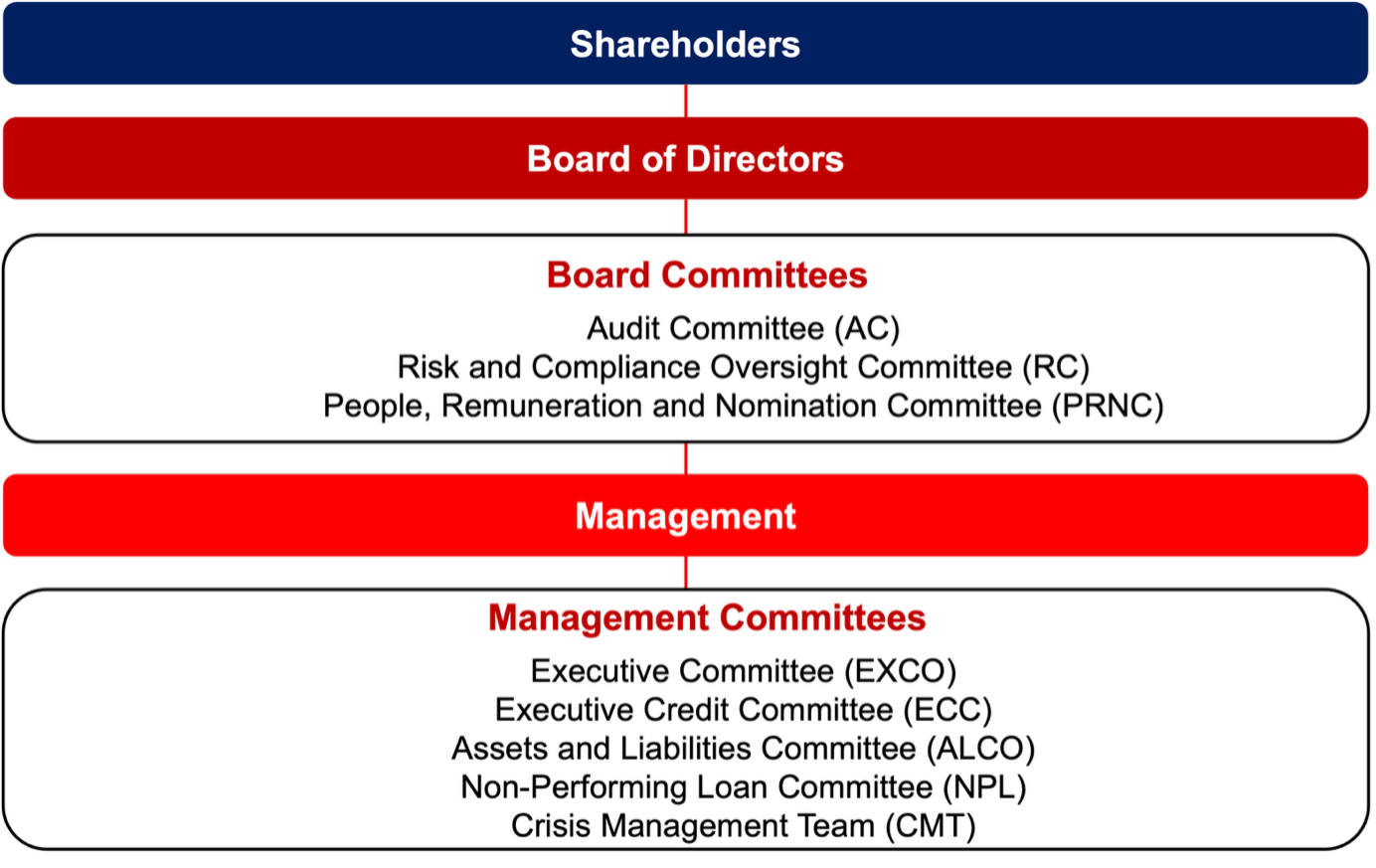
The shareholders of Yoma Bank are FMI, Greenwood Capital Private Limited (an affiliate of GIC), and Norfund, the Norwegian Investment Fund for Developing Countries. The composition of our Board of Directors evolves in accordance with the changes in the shareholding structure.

Annual General meetings are usually chaired by the Chairman of the Board. During these meetings, the shareholders:
- elect the Directors of the Board
- approve the remuneration of the Directors based on the recommendation of the Board
- appoint External Auditors
- approve the change in the share capital
- validate the allocation of the Banks’ resources.
Our most recent General Meeting was held on 28th November 2025 with our shareholders, Board of Directors, and External Auditors. The notice of this meeting can be downloaded here. The minutes of the meeting can be downloaded here.
The table below summarises the Annual General Meeting resolutions which were passed by way of written resolutions of 100% of the members according to section 156(d) of the Myanmar Companies Law 2017.
| Resolution | % for | % against | & abstention |
| A. Appointment of External Auditor | 100% | – | – |
| B. Appointment of U Tun Myat (Chairman) | 100% | – | – |
| C. Appointment of U Kyi Aye (Director) | 100% | – | – |
| D. Appointment of Dr. Thein Zaw (Independent Non-Executive Director) | 100% | – | – |
| E. Appointment of Mr. Chintaman Mahadeo Dixit (Independent Non-Executive Director) | 100% | – | – |
| F. Appointment of Mr. John Alan Staley (Independent Non-Executive Director) | 100% | – | – |
| G. Appointment of U Kyaw Soe Lin (Director) | 100% | – | – |
The Board is elected by and accountable to the shareholders of Yoma Bank. Pursuant to CBM directive no. (9/2019), the appointment of the Directors of the Board shall be staggered to ensure that the duties and functions of the Board are conducted without interruption. Except for decisions explicitly reserved for shareholders, the Board has full authority to carry out all activities necessary to provide effective strategic guidance and sound oversight, key personnel decisions, organizational structure, governance framework and practices, risk management and compliance obligations.
The following are the primary roles and responsibilities of the Board:
| Theme | Responsibilities |
| Board |
|
| Strategy |
|
| Risk & controls |
|
| Reporting |
|
| Stakeholders |
|
| People |
|
The Board reviews and approves the Risk Appetite Statement on an annual basis. The Statement defines the key risks and parameters and outlines how those risks are managed in the context of external situations and macroeconomic challenges. Leaders from Risk and Compliance divisions provide regular reports to the Risk & Compliance Oversight Committee to support robust oversight, which evaluates whether the established Risk Appetite remains appropriate considering evolving circumstances and their potential impact on the strategy and operations of the Bank.
These assessments cover critical areas such as capital and debt structure, liquidity, capital adequacy, credit collections and repayments, operational security, and human capital considerations. Any significant changes or deviations from the targets set in the Risk Appetite Statements are promptly reported to the Board to ensure timely adjustments that support the effective delivery of its strategic objectives.
Learn more about our risk management here.
The Board conducts its yearly self-evaluation to identify ways to strengthen its overall effectiveness. This evaluation process is facilitated by People, Remuneration and Nomination Committee and the findings and key observations are reported to the Board. The Observers of the Board and Leadership Team are invited to participate in the evaluation process. The evaluation is completed on a confidential basis, and it was segmented into following five key areas:
- Authorities and General Information, which assesses the Board’s authorities, roles and consideration in protecting the Bank’s interest and the shareholders’ value as well as the Board’s effectiveness in guiding and setting the strategy of the Bank and managing the performance of the Chief Executive Officer.
- Board Composition, which looks at the composition of the Board and its sub-committees.
- Structure and Committees, which covers the structure, composition, effectiveness of committees, and the deliberations of committees to non-committee members.
- Duties and Liabilities, which appraises communication to the Board on duties of loyalty, care and business judgement, learning about the Bank’s business, challenging, and asking critical questions to management, and disclosure of conflict of interest; and
- Working Procedures, which considers the effective working procedures of the Bank.
Yoma Bank adopted Related Party Transaction Policy, which is approved by the Board, to ensure that related party transactions are conducted at arm’s length with any consideration paid or received by the Bank in connection with any such transaction being on terms no less favorable than terms available to any unconnected third party under the same or similar circumstances.
The Audit Committee oversees and reviews the propriety of related party transactions to avoid any potential or actual conflict of interest. The Bank has formulated guidelines for identification of related parties and the proper conduct and documentation of all related party transactions.
The objective of the Related Party Transaction Policy is to:
- set out the materiality thresholds for related party transactions; and
- ensure proper approval, disclosure, and reporting of such transactions as applicable under the law/ regulations between the Bank and any of its related parties in the best interest of the Bank and its stakeholders.
The Board adopts a succession planning framework that outlines the succession of key management positions and provides guidance on the mechanism for CEO and senior management replacement whether in an emergency situation or as part of a planned transition. CEO provides support to the Board in this process and is part of the committee that plans for succession. The succession plan goes beyond simply naming potential leaders but also identifies plans to professionally develop the Bank’s leadership pipeline. It also leads the Board to define strategies for recruiting and retaining qualified management staff to support the growth of the Bank.
The Board reviews and updates the succession plan on a regular basis. Beyond long-term succession planning, the Board also ensures there are short-term continuity plans in place in the case of an unexpected executive absence. For key executive positions, the Board identify backups that can quickly take over a function should it be unexpectedly vacated for whatever reason. This should be part of a wider Business Continuity Plan for the Bank.
The Board adopted a remuneration and compensation framework as part of the Corporate Governance Policy. The People, Remuneration and Nomination Committee reviews this framework regularly and submits recommendations to the Board for any amendments. The purpose of the framework is to define the entitlement of Board members to receive remuneration and compensation for their service on the Board.
The Bank’s approach to employee remuneration comprises a fixed base salary complemented by variable allowances and rewards that reflect the performance of the Bank, divisional achievements, individual contributions, and compliance with the Code of Conduct. The Bank applies a holistic and fair assessment in determining total compensation, aimed at recognizing performance, motivating employees, and retaining key talents. The Board of Directors and senior management conduct regular reviews of the remuneration schemes, policies, and practices to ensure continued alignment with applicable labor laws and responsiveness to evolving market benchmarks and industry developments.
Remuneration for the Board of Directors and key management is disclosed in the financial Statement, which is available here. For the period ending 31 March 2026, these disclosures can be found in Note 7 – Related Party Transactions of the Audited Financial Statements.
The Chairman is responsible for leading the Board and ensuring its overall effectiveness. The main responsibilities of the Chairman are:
- overseeing the planning, chairing, and documentation of Board meetings, and ensuring that Board members receive timely and sufficient information to support informed decision‑making.
- ensuring that Board Committees function effectively and that the performance of Board members and of the Management Team is evaluated at least annually.
- promoting a culture of openness and constructive debate, ensuring that all Board members have the opportunity to express their views and contribute freely to discussions.
- ensuring that all Board members receive the necessary training to maintain and strengthen their understanding of the business environment. Newly appointed Board members are supported through a structured onboarding process, while existing members have access to ongoing professional development and continuous education programs.
The Audit Committee (AC) is responsible for:
- safeguarding the integrity of internal controls and financial reporting
- monitoring the effectiveness and performance of the Internal Auditor and External Auditors
- ensuring compliance with relevant laws and regulations
The following table summarises the main areas of responsibilities of the Audit Committee:
| Theme | Responsibilities |
| Compliance |
|
| Risk & Controls |
|
| Reporting |
|
The Risk and Compliance Oversight Committee are responsible for:
- overseeing the identification and definition of risks inherent to the Bank’s business and activities including credit, market, operational, liquidity, reputational, strategic risks, etc.
- ensuring the effectiveness of the risk management, risk appetite framework and overall control environment of the Bank
- exercising independent oversight of the compliance function by reviewing significant compliance issues and monitoring the progress of remediation plans
- ensuring adherence to applicable laws, regulations, and internal policies and assessing that the Bank’s policies and procedures are adequate to detect, prevent, and respond to compliance risks
The following table summarizes the main areas of responsibilities of the Risk and Compliance Oversight Committee:
| Theme | Responsibilities |
| Compliance |
|
| Risk & controls |
|
| Reporting |
|
The People, Remuneration and Nomination Committee is responsible for:
- approving the organization structure of the Bank
- recommending the appointment, and reviewing the performance of directors, CEO, and key personnel of the senior management
- approving the Bank’s succession plan and identification of critical roles
- recommending the Bank’s performance management plan to the Board, while ensuring that its rewards and incentive approach is aligned to the Board’s vision and business objective of the Bank
| Theme | Responsibilities |
| Organization |
|
| People |
|